
Circular Economy in office partitions: opportunities and design strategies
Summary: Guidelines, specification criteria and real-world applications for designers and specifiers integrating the circular economy into office partitions.
As in most industrial sectors, circularity is widely recognised in the construction world as one of the indispensable approaches to design, for the judicious use of resources and for managing the procurement, production and installation process. In the office building sector, the flexibility of spaces and the reuse of fit-outs make circular design a tool capable of expanding the range of available technical solutions.
In this context, demountable partitions can prove to be a product whose potential goes well beyond dividing and articulating space. Correct design and specification transform them into strategic solutions for office fit-out.
In This Article:
Why circularity matters in building and construction
Demountable partition and the circular design opportunity
Specifying circular partition systems: technical considerations
From specifier to client: Circular Economy strategies
Sources
Why circularity matters in building and construction
The push towards the Circular Economy officially began in 2015, with the European Commission’s launch of an action plan that defines a new model of production and consumption. In the Commission’s own words, this is a model that:
“involves sharing, leasing, reusing, repairing, refurbishing and recycling existing materials and products as long as possible. In this way, the life cycle of products is extended. In practice, it implies reducing waste to a minimum. When a product reaches the end of its life, its materials are kept within the economy wherever possible thanks to recycling. These can be productively used again and again, thereby creating further value”.
European Commission, Circular Economy Action Plan, 2015
The construction sector deserves particular attention in this context. It is an established fact that construction represents the sector with the greatest impact on resource consumption among all anthropogenic activities; according to the United Nations, in fact:
- ~ 32% of global energy consumption is attributable to construction
- ~ 34% of global greenhouse gas emissions comes from the same sector
In particular, with regard to the use of materials, a recent Arup study shows that:
- ~ 50% of the materials extracted each year is used in the construction sector, 15% of which is lost during the construction process itself.
The potential benefits of adopting a circular model are proportional to this scale of impact. Again, according to Arup, applying Circular Economy principles to the construction materials sector could reduce global greenhouse gas emissions by 38% and cut 2.1 billion tonnes off emissions from the construction and demolition of buildings by 2050. Data of this magnitude make the shift to a circular model necessary, and indeed inevitable.
Demountable partition and the circular design opportunity
Demountable partitions are products that, by their nature, lend themselves to a circular design approach. Dimensional parameters, finishes and componentry remain unchanged over time, which allows demountable partitions to be used potentially an unlimited number of times. The main materials used to assembly them, glass and aluminium, have a long useful life, which amplifies the possibilities for reuse.
Office buildings represent the most favourable context for applying these principles. Unlike other building types, such as hospitals or schools, whose useful life tends to be longer, offices are more subject to refurbishment, also for reasons that are not strictly functional. In this context, again according to studies carried out by Arup, approximately 60% of demountable walls and suspended ceilings can be reused without modification, while the remaining 40% is usually altered due to holes made for cabling or lighting, which significantly reduces the possibilities for reuse.
Three design strategies stand out as the prevailing approaches for achieving circularity objectives in this area:
- Buildings as ‘banks of materials’: the building as a repository of materials that can be recovered and reintroduced into the production cycle.
- Urban Mining: the systematic recovery of materials and components from existing buildings.
- DfD (Design for Disassembly / Design for Deconstruction): design oriented from the outset towards the disassembly and recovery of components.
Spiralis Europe, a specialist in the design and supply of demountable office partitions, operates with deep-rooted experience in the sector. This experience allows the company to embrace these strategies in its own projects. It supports designers and consultants in defining Circular Economy-specified solutions from the earliest stages of the project.
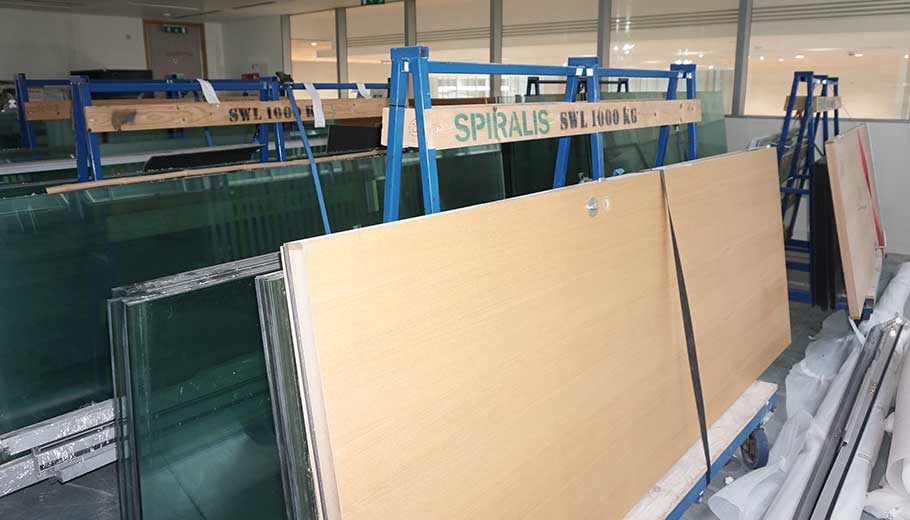
Partition materials retrieved for re-installation on new layout for 100% re-use.
Specifying circular partition systems: technical considerations
Specifying demountable partitions from a Circular Economy perspective requires precise technical choices, which concern both glazed components and solid parts. The decisions made at the design stage significantly determine the possibilities for recovery, reuse and recycling at end of life.
Glass selection and recyclability
The construction of a demountable wall normally requires the use of safety glass, whether laminated or toughened. In addition to the search for products with reduced environmental impact, as in the case of low carbon glass, the choice between the two types has direct implications for the recyclability of the component.
Toughened glass is easily recyclable. Unlike laminated glass, it does not require separation from PVB (polyvinyl butyral) before being reintroduced into the production process. For this reason, Spiralis Europe’s design choice favours toughened glass, where possible, owing to its greater margin of recyclability.
Spiralis Europe’s objective is to collaborate with glass supply chain operators who commit to recovering the product supplied at the end of its life, to recycle it and reintroduce it into new architectural projects. This supply chain strategy transforms the material specification into a recovery agreement. It integrates the Circular Economy into the procurement process.
Solid panels: reusable solutions vs. plasterboard
The same logic applies to the solid parts of demountable walls: Spiralis Europe favours solutions with components that remain reusable over time. For instance, when comparing demountable partitions with drylining, gypsum walls offer a lower initial capital investment. However, they cannot be re-used if the walls are relocated, requiring them to be dismantled, the materials disposed of, and the walls rebuilt in a new location, followed by a new installation and decoration cycle. At the end of their working life, apart from targeted recycling initiatives that require uncontaminated waste streams, plasterboard generally ends up in landfill as general waste. Wood particle boards are instead easy to re-introduce in a new production cycle to obtain brand new boards of similar characteristics. Solutions with reusable components allow full recovery of materials with ease and fit coherently into a specification geared towards circularity.
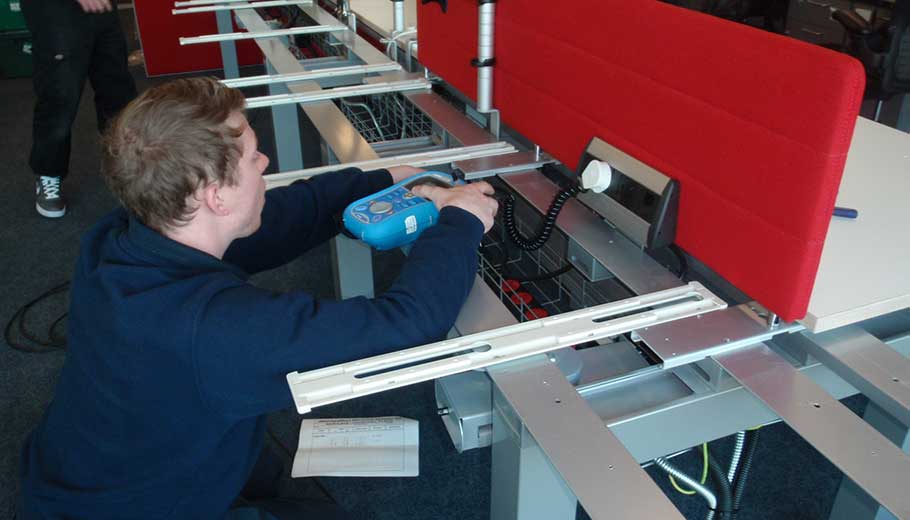
Modernisations of desks re-using desk structure with new acoustic panels and worktops.
From specifier to client: Circular Economy strategies
Designing demountable partition systems from a circularity perspective is without doubt the most effective strategy for reducing environmental impacts. It allows for the reuse of wall components and enables compliance with various certification protocols (BREEAM, LEED, etc.).
In this context, it is essential that everyone involved in the process of using demountable partitions, from the specifier to the client to the supplier, follows certain design principles as closely as possible:
- the use of reversible mechanical connections instead of permanent fixings: for example, screws, mechanical fasteners, joints, in place of welding or gluing;
- material composition: pay particular attention to characteristics such as recycled content, end-of-life recyclability, mono-materiality (which allows easier separation of components), the presence of certifications (EPD, ecolabel, etc.);
- dimensional modularity: the adoption of dimensions and/or shapes in components that are as modular as possible, without however modifying or altering the overall design, which is tailored and customised according to the client’s specific requirements;
- component mapping: the possibility of obtaining a “digital passport” that certifies the nature of the materials used, their origin, the correct methods of application, etc.;
- site management: favour reusable packaging systems, facilitate off-site prefabrication and reduce waste and offcuts.
Spiralis Europe has for some time been focusing its actions on the widespread and ongoing adoption of a design approach oriented towards the Circular Economy, a strategy that aligns with the current construction context and supports the goal of preserving greater value over the lifetime of the project, with clear benefits for everyone involved in the process of designing demountable partition systems.
Sources
European Commission, Circular Economy Action Plan, 2015.
United Nations Environment Programme, Not just another brick in the wall: the solutions exist – scaling them will build on progress and cut emissions fast. Global Status Report for Buildings and Construction 2024/2025, 2025.
Arup, The Reuse Playbook, 2020.