
Low-carbon glass cuts embodied carbon in office partitions
Summary: Declared GWP data, embodied carbon figures for single and double glazing, and the recycling limits that shape low-carbon glass specification.
Almost all construction materials are undergoing a period of profound renewal in light of scenarios concerning environmental impact, the containment of energy consumption (both during production and during the use of buildings), and the need for a more careful use of raw materials. Glass is no exception. Its use in commercial buildings, and in particular in internal partitions, has taken on an increasingly important role.
In this context, low-carbon glass represents the latest generation of glass for architecture. It contributes strongly to meeting environmental requirements without compromising technical or performance characteristics and adds clear value to the architectural quality of the project.
In This Article:
Evolution of glazed partition systems in offices
Technical profile of low-carbon glass
Embodied carbon in single and double glazing
Recycled content as a low-carbon criterion
Recycling limits for architectural glass
Producer selection in the circularity process
Specification strategies for low-carbon glass
Sources
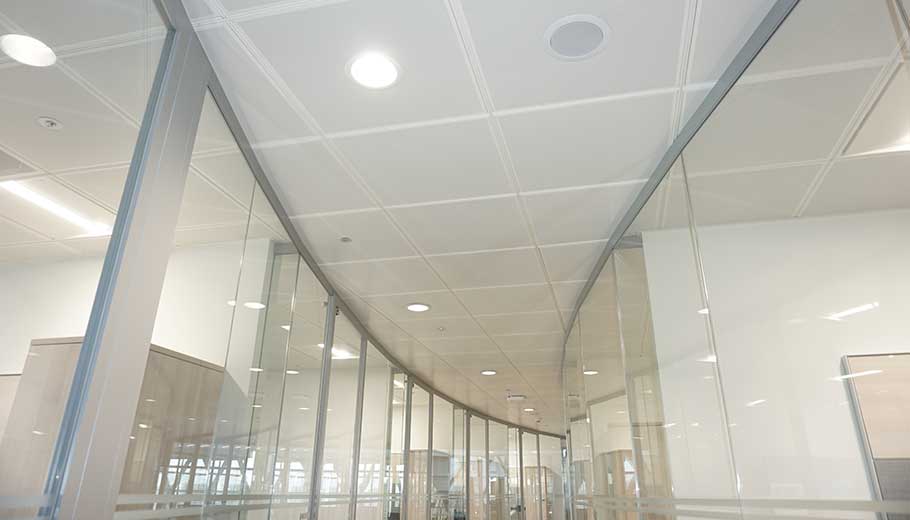
A partition wall made entirely of glass in a contemporary office building.
Evolution of glazed partition systems in offices
Spiralis Europe has worked in the office fit-out sector for over 40 years and has closely followed the evolution of the glass used in internal partitions. The transformation from framed glass partition systems, generally with steel profiles, to structural, frameless glass systems has, among its natural consequences, increased the thickness of the panes, which have gone from a typical thickness of 6 mm to 10, 12, 16, 22 mm and even more. One of the side effects is an increase in the carbon emission required to support the additional mass.
Another area that has changed profoundly compared with the past is the balance between single glazing and double glazing. In the early years of the twenty-first century, most projects used single glazing, whereas today wall systems with double glazing prevail, chosen mainly for their acoustic performance. A further change has been the shift from clear glass to extra-clear glass. Interior wall projects now often feature low-iron panes, oriented towards maximum transparency. All factors that have led to an increase in the amount of carbon, and that call strongly for a move towards an ever more widespread use of low-carbon glass.
Technical profile of low-carbon glass
As with aluminium, low-carbon glass is a type of glass designed to significantly reduce the environmental impact generated during the production process, from the extraction of raw materials through to transformation into the finished product, which account for the main share of energy consumption. According to the analysis by R. Hartwell, G. Coult and M. Overend, in flat glass production the extraction and transport of raw materials accounts for 24% of consumption and the melting stage for 61%. The transformation into the finished product accounts for 15%.
Low-carbon glass retains all the characteristics of the glass commonly used in architecture, without altering or compromising the final effect of the project. Unlike other types of glass, however, low-carbon glass production is distinguished by particular attention to certain aspects, such as the producer’s sourcing of raw materials, the energy efficiency of production plants, and the distance and mode of transport of the semi-finished product from the producer to the site where the finished product is assembled. Various indicators in the technical documentation of the finished product provide information on its environmental impact, such as the carbon footprint measurement, kgCO2eq/m2, and the recycled content.
Declared carbon footprint across product lines
In this regard, as with aluminium, several product lines are already available, for which manufacturers provide detailed information, especially concerning Global Warming Potential (GWP):
AGC Low-carbon Glass
According to AGC documentation, a GWP of 4.8 kgCO2eq/m2 for 4 mm float glass, with at least 60% recycled content.
Guardian NEXA 6
According to Guardian Glass documentation, a GWP of 6.38 kgCO2eq/m2 for a 4 mm glass thickness, equivalent to -36% compared with European average float glass.
Pilkington Mirai™
According to Pilkington documentation, a GWP of 5 kgCO2eq/m2 and -52% embodied carbon compared with standard Pilkington float glass.
Saint Gobain ORAÉ®
According to Saint-Gobain Glass documentation, a GWP of 6.64 kgCO2eq/m2 (from Cradle to Grave for a 4 mm-thick pane), -42% embodied carbon compared with the Saint-Gobain Glass European standard for clear glass, and 64% recycled content.
The market therefore offers several low-carbon glass options, particularly in view of strong projected market growth, which according to Insight Ace Analytic will reach 4.7% annually until 2031, most of it in the building&construction sector and, specifically, in the commercial sphere.
Embodied carbon in single and double glazing

Growth forecasts for the low-carbon glass market by application sector, according to Insight Ace Analytic. Source: Adapted from InsightAce Analytic.
In other words, in the coming years low-carbon glass will find its main application precisely in commercial buildings, including as a component of internal demountable partitions, with clear benefits in terms of reducing environmental impact in both single-glazed and double-glazed versions.
| Partitioning walls | Carbon-intensive Glass | With 30% recycled Glass | Low-carbon glass |
|---|---|---|---|
| Double glazing 10mm – 1m² | 57 kgCO₂eq | ~46 kgCO₂eq | 33.2 kgCO₂eq |
| Single glazing 1m² | 28.5 kgCO₂eq | ~23 kgCO₂eq | 16.6 kgCO₂eq |
The values are based on data from the Environmental Product Declaration (EPD) of Saint-Gobain Glass. The values for standard glass and low-carbon glass are calculated based on the data declared for 4 mm-thick float glass and scaled proportionally to a thickness of 10 mm. The scenario with 30% recycled content represents an estimated intermediate value, based on the relationship between the increase in recycled content and the reduction in embodied carbon.
Recycled content as a low-carbon criterion
The theme of recycling is, in the context of reducing the environmental impact of construction materials, one of the themes that most contributes to defining the characteristics of low-carbon glass. As an example, Europe is particularly virtuous in the recycling of packaging glass. According to an estimate by Close the Glass Loop, it has reached excellent levels, with almost 81% of glass recycled by 2023.
The goal of an ever-lower environmental impact for glass products remains unchanged when operating in the construction sector, given the scale of the market. According to Market Reports World, the market is worth almost 60 billion dollars in 2024 and will exceed 77 billion by 2033. In light of the evolution of internal partition systems, which has led to the widespread adoption of double glazing, it is clear that sector operators need to maintain constant commitment to project management, at every stage.
Recycling limits for architectural glass
Despite the technical possibility, as with aluminium, of potentially infinite recycling, it is not always possible to reuse panes produced for architectural use. The use of clean, annealed or tempered recycled glass in the production process for new architectural glass is advantageous for achieving a lower-energy-impact process, but this does not apply to laminated glass. Separating the interlayer is problematic and not economically sustainable at the moment, and is carried out, at best, only in the automotive industry.
A further difficulty is presented by low-iron specifications. Generally, the availability of recycled glass cullet with the same specifications is rare, and the availability of glass that is both low in carbon and low in iron is also very limited.
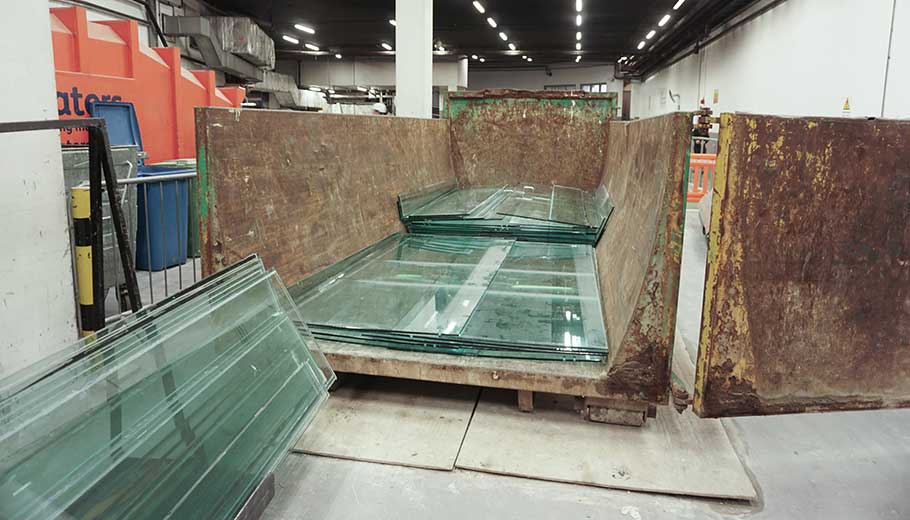
On-site collection of clean tempered glass destined for 100% recycling in the production of new partition glass.
Producer selection in the circularity process
It is therefore important for Spiralis Europe to select the producers that are more committed than others to this process, and in particular to become part of the circularity process in order to feed the production process through targeted disposal. In this way, Spiralis manages to change the “traditional” approach, which consists of passing the technical specifications of the glass to the producer, who then supplies a standard product. Instead, it encourages project choices towards glazing systems with declared sustainability characteristics, with the aim of strengthening the market with valid, reusable recyclable components.
In the design phase, especially when dealing with clients and specifiers, Spiralis Europe’s commitment is oriented towards also proposing solutions that provide for the use of low-carbon glass. This commitment extends to modifying the technical specifications of the project, without altering the intended result, so as to allow the use of glazing products that fall within the low-carbon glass category. A form of design support that, as in the case of the Fitch Ratings project recently completed, analyses the data collected on the characteristics of the glass and helps the client make the most suitable choices for their project, from a sustainability perspective.
Specification strategies for low-carbon glass
Low-carbon glass is characterised by greater technological innovation and the use of renewable energy. It also contains a significant amount of glass cullet. It is currently used only in selected formats and thicknesses. Specific applications for projects must therefore be assessed on a case-by-case basis, according to available stock and project requirements.
From a technical standpoint, tempered glass, whether low in iron or with reduced iron content, offers 100% recyclability for the production of architectural glass within a circular economy. Laminated and acoustic glass from construction sites, however, is not recycled to produce new glass, but it is usually crushed for use as aggregate or sent to landfill.
Spiralis Europe works daily to introduce the use of low-carbon glass as much as possible in the design and construction of partition walls in office buildings, since this represents one of the most effective ways of making the construction sector more sustainable globally. The demountable partition wall sector can make a fundamental contribution. It can help ensure that glass is designed to be both easily separable from frames and recoverable from construction sites. It can also ensure the glass has technical characteristics suited to recycling for the production of new glass, whether standard or low in iron.
Sources
R. Hartwell, G. Coult, M. Overend, Mapping the flat glass value-chain: a material flow analysis and energy balance of UK production, 2022.
AGC Glass Europe, Low-carbon Glass, agc-yourglass.com
Guardian Glass, Guardian NEXA 6, guardianglass.com
Pilkington, Pilkington Mirai™, pilkington.com
Saint-Gobain Glass, ORAÉ®, saint-gobain-glass.com
Saint-Gobain Glass, Environmental Product Declaration (EPD): ORAÉ® low-carbon glass substrate 4 mm, International EPD® System, EPD registration no. S-P-08970.
Insight Ace Analytic, Low-carbon Glass Market, insightaceanalytic.com
Close the Glass Loop, Glass collection for recycling rate in 2023, closetheglassloop.eu
Market Reports World, Construction Glass Market, marketreportsworld.com