
Low-carbon aluminium in office partition walls and fit-outs
Summary: Low-carbon aluminium cuts embodied carbon in glazed partitions. What qualifies the material and how specifiers should approach it.
Aluminium has gone from a precious material in antiquity to a leading presence in every area of daily life. Today it plays a major role in the production of almost all the objects and devices used in residential and workplace settings.
In the commercial buildings sector, the increasingly widespread use of aluminium has enabled a paradigm shift in the potential applications of internal partitions and has broadened the range of solutions available to designers. Low-carbon aluminium now presents itself as the most advanced version of the material, capable of contributing to the reduction of environmental impact without detracting from the quality of the finished product.
In This Article:
The environmental footprint of primary aluminium production
Qualifying criteria for low-carbon aluminium
Embodied carbon reduction in aluminium partition walls
Design levers for low-carbon partition specification
Long-term value of sustainable office fit-out materials
Recycling constraints for specifiers and clients
Sources
The environmental footprint of primary aluminium production
In the world of demountable walls, and more generally in the world of commercial buildings, aluminium plays a leading role. Designing and operating to reduce the environmental impact resulting from its use is an obligation for anyone who carries out interior fit-out projects. Some recent data clearly illustrate how important it is to move in this direction.

Primary aluminium, obtained from the extraction of bauxite ore, concentrated in the southern hemisphere. Source: Adapted from ftmmachinery.com.
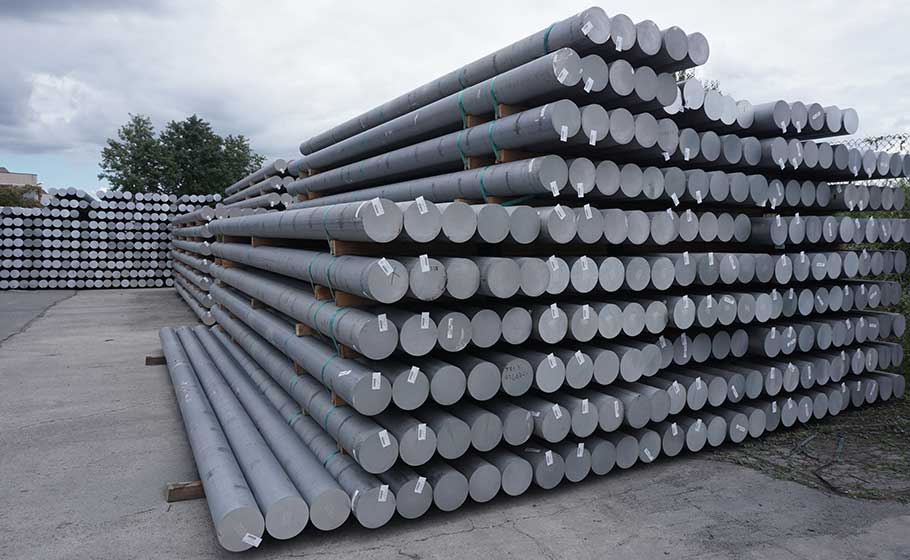
Stock of ‘billets’ ready for the profile extrusion process.
- according to Material Economics, global production of primary aluminium is approximately 60 million tonnes a year, and continues to increase;
- according to One Click LCA, the production of primary aluminium is responsible for approximately 4-5% of global electricity consumption, and generates more than a gigatonne of carbon;
- still according to Material Economics, to meet forecast future demand, global production by 2050 will need to more than double.
Against this backdrop, One Click LCA has estimated that the use of low-carbon aluminium could reduce carbon production by 60%.
Qualifying criteria for low-carbon aluminium
The definition of low-carbon aluminium has been present on the market for internal partitions, and more generally in the components sector for office buildings, for a relatively short time, following the technological innovation introduced by raw material manufacturers. Two distinct indicators qualify the material: recycled content and carbon footprint.
Recycled aluminium content in the production stream
As with glass, one characteristic common to low-carbon aluminium relates to the fact that the plants used by primary aluminium producers are powered by renewable energy. The second indicator is the use of recycled material.
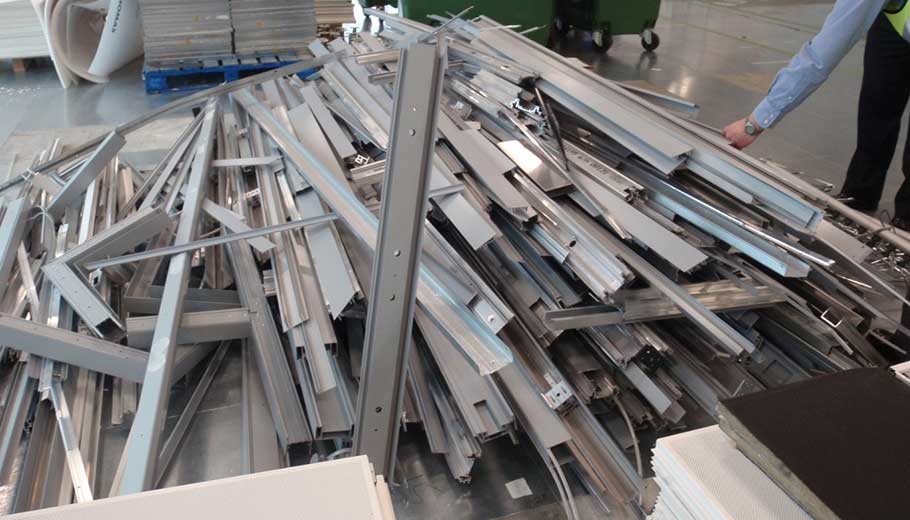
As with glass, and even more so, aluminium has characteristics that favour potentially unlimited recycling. Once the compliance of the recovered alloy for reintroduction into the production chain has been verified, it can ideally be reused indefinitely.
According to One Click LCA, the production of aluminium through recycling could currently meet less than 30% of global demand; however, Material Economics estimates that by 2050 the quantity of recycled aluminium could double, but with the increased demand the percentage could remain unchanged.
Carbon footprint thresholds for low-carbon classification
According to MECLA and Carbon Trust, the reference value for classifying aluminium as low carbon is generally the threshold of 4 tonnes of CO₂ emitted per tonne of aluminium produced, one third of the global average threshold.
Published carbon footprint data from aluminium manufacturers
As with glass, several manufacturers provide carbon footprint data for their low-carbon products. The information reported below is drawn from the websites and technical documentation made available by manufacturers.
Carbon footprint and recycled content data declared by leading aluminium manufacturers for architectural applications.
ALCOA
EcoLum® Below 5.0 tonCO2eq/ton aluminium
EcoDura® Minimum 50% recycled content PCS – Post-Consumer Scrap
Hydro CIRCAL 75R
1.9 kgCO2eq/kg aluminium
Minimum 75% recycled content PCS – Post-Consumer Scrap
Rusal Allow
2.2 tonCO2eq/ton aluminium
Fonderie Pandolfo
FuturAl 50 1.55 tonCO2eq/ton aluminium
Minimum 50% recycled content PCS – Post-Consumer Scrap
FuturAl 85 1.23 tonCO2eq/ton aluminium
Minimum 85% recycled content PCS – Post-Consumer Scrap
FuturAl 100 0.57 tonCO2eq/ton aluminium
100% recycled content PCS – Post-Consumer Scrap
In this context, Spiralis Europe is actively committed to working with suppliers that have launched initiatives to reduce the environmental impact of their products, also in light of the ongoing evolution of demountable wall systems.
Embodied carbon reduction in aluminium partition walls
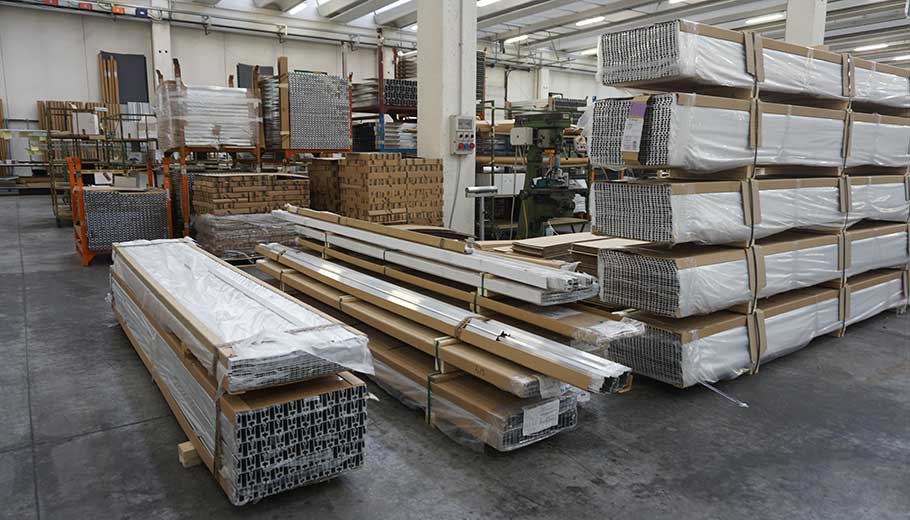
Production facility for demountable partitions; components ready for the cutting and milling of profiles to be integrated into the final product.
The evolution of demountable walls from single-glazed to double-glazed systems has also had an impact on the technical solutions for fixing the glass, particularly the frames. Fixing systems, originally almost exclusively made of steel, are today predominantly made of aluminium, and this results in greater ease of recycling.
The size of the glazing retention structure has therefore reduced compared to the past. The nature of aluminium as a material, which requires high energy consumption for its production, nonetheless requires a profound rethink in its use, towards technical solutions capable of meeting the needs of any client without compromising performance.
Aluminium alone accounts for approximately 50% of the embodied carbon of a double-glazed internal partition. Using low-carbon aluminium, according to One Click LCA, this impact can be reduced by up to 29%.
| Partitioning walls | Carbon-intensive primary aluminium | With 30 % recycled aluminium | Low-carbon aluminium |
|---|---|---|---|
| Double glazing 1m² | 101 kg CO₂eq | 87 kg CO₂eq | 72 kg CO₂eq |
| Single glazing 1m² | 60 kg CO₂eq | 51 kg CO₂eq | 42 kg CO₂eq |
Comparison of embodied carbon in aluminium partition walls. Source: One Click LCA.

Reduction in carbon emissions across different scenarios for aluminium partition walls. Source: One Click LCA.
One Click LCA has also shown that in projects involving the replacement of internal partitions, for example due to a change of occupant or following renovation work, the use of low-carbon aluminium can reduce the amount of embodied carbon by 11%.
Design levers for low-carbon partition specification
An internal partition project characterised by low environmental impact that involves the use of low-carbon aluminium operates on two levels.
The first involves measures that reduce the primary energy used for production and transport, and consequently the amount of embodied carbon in the product: the use of components supplied by manufacturers whose plants are powered by renewable energy, the amount of recycled material present in the finished product, and the distance from the place of production, smelting plant, extruding plant, fabrication plant to the project site.
The second involves the use of components designed to achieve a reduced carbon footprint, for example by reducing the thickness of the profiles in order to use less material, without thereby altering the system’s mechanical and acoustic performance.
Long-term value of sustainable office fit-out materials
Spiralis Europe, as a designer and supplier of demountable internal partitions with an aluminium structure, is therefore ideally positioned to engage, on one hand, with client requirements and, on the other, with a range of manufacturers able to meet the demand for reduced environmental impact material.
With the aim of reducing environmental impact as much as possible, Spiralis Europe pays close attention to engaging with operators where the energy impacts of the various production stages – from bauxite extraction to refining and smelting – are kept strongly under control.
In this context, the use of low-carbon aluminium in the supply of internal partitions is now increasingly presenting itself as an almost obligatory choice. The relatively higher economic commitment required for its use is amply offset by the long-term revaluation of the product used, and at this point it becomes an investment for the client: the value of an asset whose impact on the environment is shown to be strongly reduced.
Recycling constraints for specifiers and clients
Since the use of low-carbon aluminium is set to increase over the coming decades, it is important for designers and clients to take into account some principles relating to its application in partition walls and office furnishings:
- low-carbon aluminium requires extensive use of renewable energy, rather than fossil fuels, especially in the extraction and smelting processes, or the use of a high percentage of recycled material in the production of billets intended for the final extrusion process, mixed, for technical reasons, with a certain amount of primary aluminium;
- the aluminium alloys commonly used in extrusions for architectural components are 6060 and 6063, and require the use of similar materials for recycling purposes to obtain the same characteristics;
- the value of aluminium scrap is high, does not require further incentives to guarantee recycling, and the process brings various economic advantages, provided that the separation of components is straightforward;
- European foundries automatically use all available suitable aluminium scrap, at a concentration of approximately 25-30%;
- European low-carbon aluminium programmes for the construction sector are currently based on a high percentage of recycled aluminium, 75%, rather than using renewable energy at source, and this reduces the availability of aluminium scrap for standard production;
- also a high amount of recycled aluminium involves a more complex refining and sorting process in order not to compromise the properties of the alloy and reduces futher the overall global recyclability potential compared with less intensive use of the same material.
The use of low-carbon aluminium can have a positive impact at a global level, as it drives the use of renewable energy and advanced technologies. Spiralis Europe constantly improves its expertise to stay up to date with all technological developments, with the aim of optimising the construction process and supporting designers and clients in the integration of aluminium products and components, with clear environmental benefits in the design and construction of partition walls and office furnishings.
Sources
Carbon Trust, The case for low carbon primary aluminium labelling. Methodology statement to define the market category.
FTM Machinery, Global use of bauxite and bauxite reserves left to human, ftmmachinery.com.
International Aluminium, Low-carbon aluminium factsheet.
Material Economics, The Circular Economy a Powerful Force for Climate Mitigation. Transformative innovation for prosperous and low-carbon industry.
MECLA, Low-carbon aluminium. Specification Guide.
One Click LCA, Low-Carbon Aluminium Solution For Sustainable Construction & Renovation.
Alcoa, Sustana®, alcoa.com
Hydro, Circal, hydro.com
Rusal, Allow, rusal.eu
Fonderie Pandolfo, FuturAl, fonderiepandolfo.com